Macau Water Show: What Happens Inside The Pool At City of Dreams
A trailer shows you splashes and divers. It does not show you the eight hydraulic elevators under the water, the 270-degree house, or why row A of every section comes with waterproof gear.
Short answer
The Macau water show is The House of Dancing Water at City of Dreams, Cotai: a 90-minute, no-intermission aquatic spectacle staged over a 17 million litre pool that converts to a solid floor in about a minute. Tickets run from MOP 698 in Gallery to MOP 1,598 Golden Circle, and the show performs Wednesday to Sunday.
A trailer of the Macau water show gives you about thirty seconds: a diver falling from a great height, a wall of water, motorcycles in the air. What it cannot give you is the engineering underneath, and that engineering is the whole reason the show looks the way it does. The Dancing Water Theatre at City of Dreams was purpose-built around a pool holding 17 million litres of water, the equivalent of more than five Olympic-sized swimming pools, and almost everything an audience sees is a consequence of that one decision. This guide explains the production for someone who has only ever seen the trailer: how the stage transforms, what the dives and stunts actually involve, and why the seat you choose changes the show you watch.
What Is The Macau Water Show At City of Dreams?
The Macau water show is The House of Dancing Water, a resident aquatic spectacle inside the Dancing Water Theatre at City of Dreams on Cotai, staged over a 17 million litre pool with a cast and crew of nearly 300 from more than 30 countries. It runs about 90 minutes with no intermission, performs twice daily, and is normally dark on Mondays and Tuesdays.
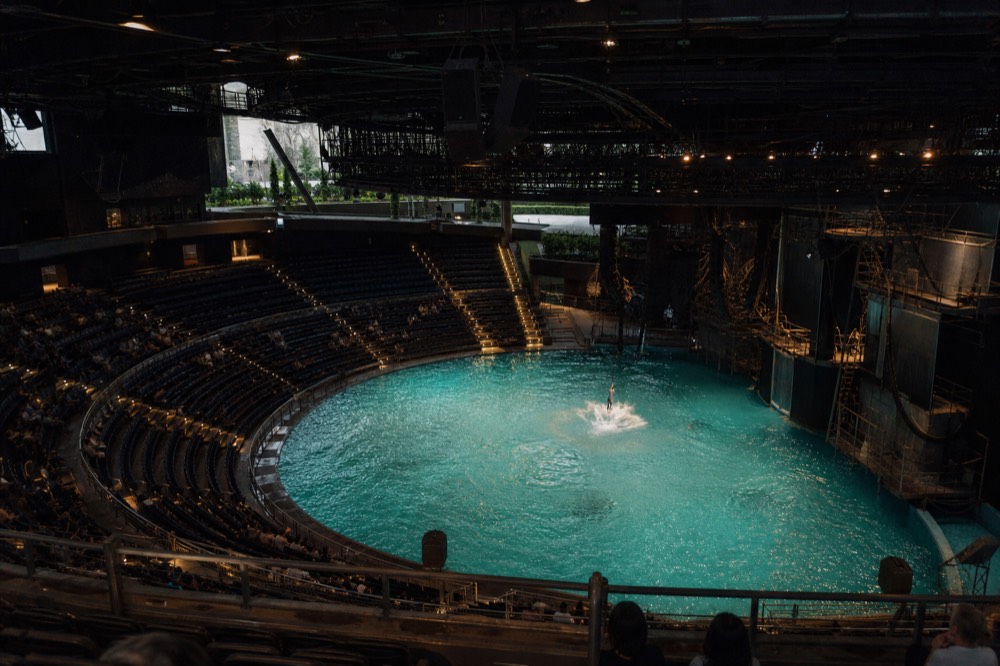
The venue calls itself the world's largest water-based show, and the claim rests on the pool: 3.7 million gallons, or 17 million litres, sitting under a 65-foot diameter centre performance area. The theatre itself is a 270-degree theatre-in-the-round, a sweeping design that puts the audience on three sides of the action rather than the single proscenium face most shows use. The theatre consultant who designed the venue describes it as a circus-based theatre-in-the-round, which is the honest architectural description: this is a circus tent's sightlines married to a diving tank.
One point of confusion worth clearing up immediately. The production that ran from 2010 to 2020 was directed by Franco Dragone, who died in 2022 and is not credited on the current show. The reimagined version carries new stage design, new costumes, new music, new scenes and a new comedic character called Sailor, and it premiered on 7 May 2025 with public performances from 9 May. Older articles still describe the retired production, so if you read about the show elsewhere, check which version the writer is describing. The relaunch is covered in detail in our House of Dancing Water reopening guide.
The show has no language barrier at all, which is part of why it sells to such a mixed international house. The official FAQ is blunt about it: performers express the story through acrobatics, not dialogue, so the production plays identically to a Cantonese speaker, a Mandarin speaker and a visitor from Ohio. The storyline follows Princess Aani, the stranger Jean, the Dark Queen Lillith and the fisherman Zhong through a fairly simple quest structure, and the plot exists mostly as scaffolding for the physical sequences. You do not need to follow every beat to enjoy a 25-metre dive.
How Does The Pool Drain And Refill Under The Performers?
The stage floor converts from open water to a solid performance platform in about a minute, driven by 32 hydraulic cylinders that operate eight 10-ton hydraulic elevators under the 65-foot centre area. Performers dive when the pool is open, then the floor rises beneath them for ground-based acrobatics, and the cycle repeats throughout the 90 minutes. This is the show's signature trick and the reason the theatre exists at all.
The mechanics, as described by the theatre design consultancy behind the venue, are straightforward in principle and enormous in scale. Eight elevators, each rated at 10 tons, lift platform segments flush with the water surface to form a dry stage, then sink to open a pool for diving and swimming sequences. Around them, more than 239 water jets create fountain effects reaching 18 metres high, and 16 underwater cameras plus over 200 safety devices monitor the performers in real time from below. The numbers are not decoration; they are the safety system that lets high divers and motorcyclists share one space on a rotating schedule.
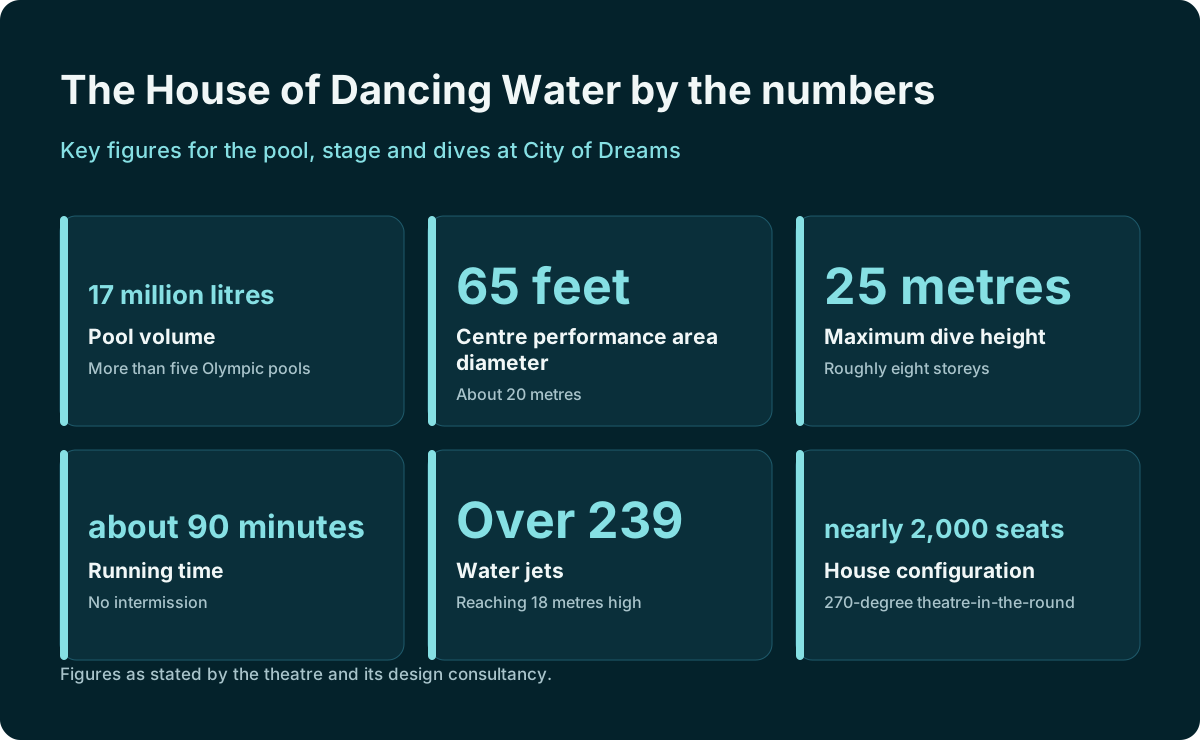
| Engineering figure | Value | What it means for the audience |
|---|---|---|
| Pool volume | 17 million litres | More than five Olympic pools; dives happen over real depth |
| Centre performance area | 65 feet (about 20 metres) diameter | The action zone the whole house faces |
| Stage elevators | Eight, 10 tons each, 32 hydraulic cylinders | Dry floor to open water in about a minute |
| Water jets | Over 239, reaching 18 metres high | The fountain walls that screen scene changes |
| Underwater cameras | 16 | Performer safety monitoring below the surface |
| Maximum dive height | Up to 25 metres | Roughly eight storeys, head-first |
| House configuration | 270 degrees, nearly 2,000 seats | Three sides of sightline, no bad geometry |
How High Are The Dives, And What Happens In The Motorcycle Sequence?
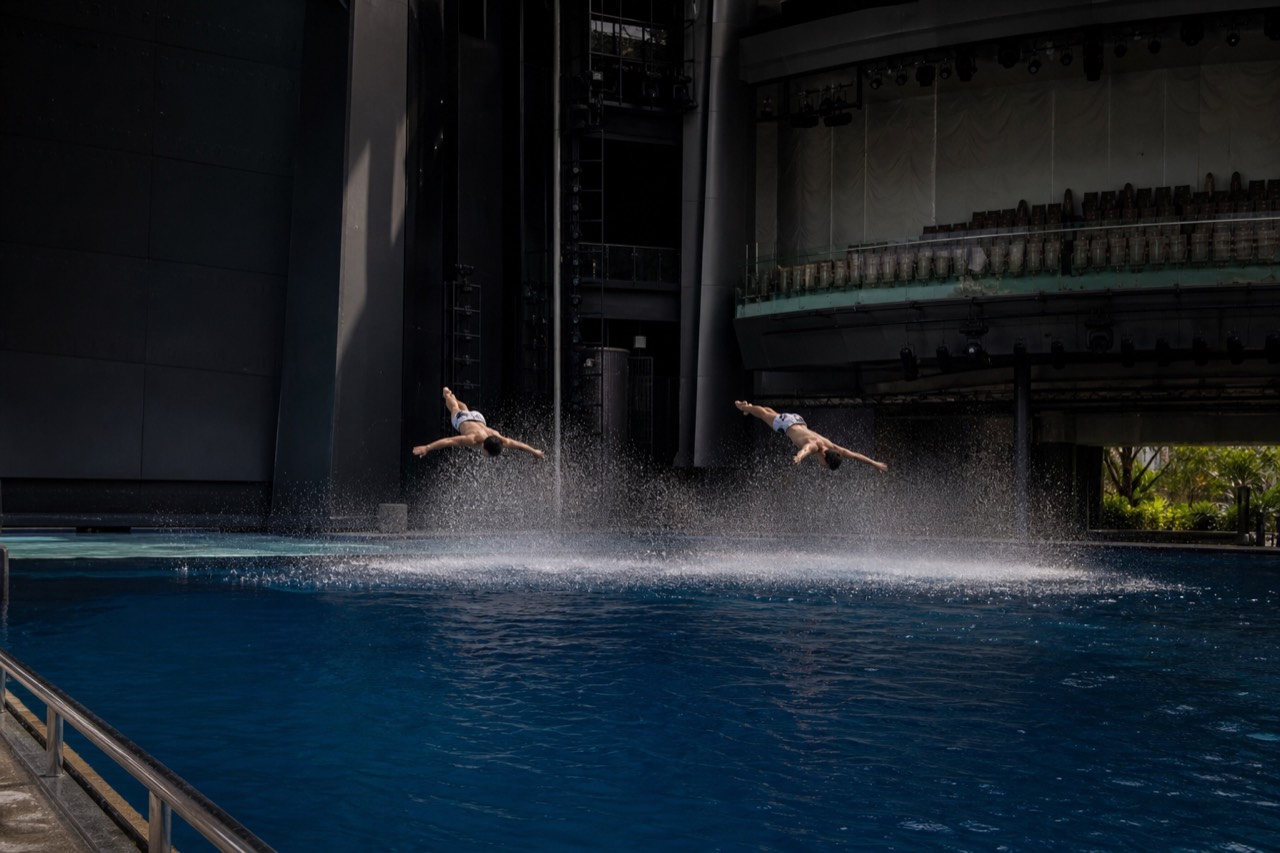
Divers fall from heights of up to 25 metres, roughly eight storeys, into the centre pool, and a motorcycle stunt sequence sends riders airborne across the water stage with pyrotechnics and loud audio effects. Both are signature set pieces of the 90-minute show, and both are reasons the front rows get wet: the official disclaimer warns of hydro effects including splashes that reach the front rows. There is no intermission, so the sequences run back to back.
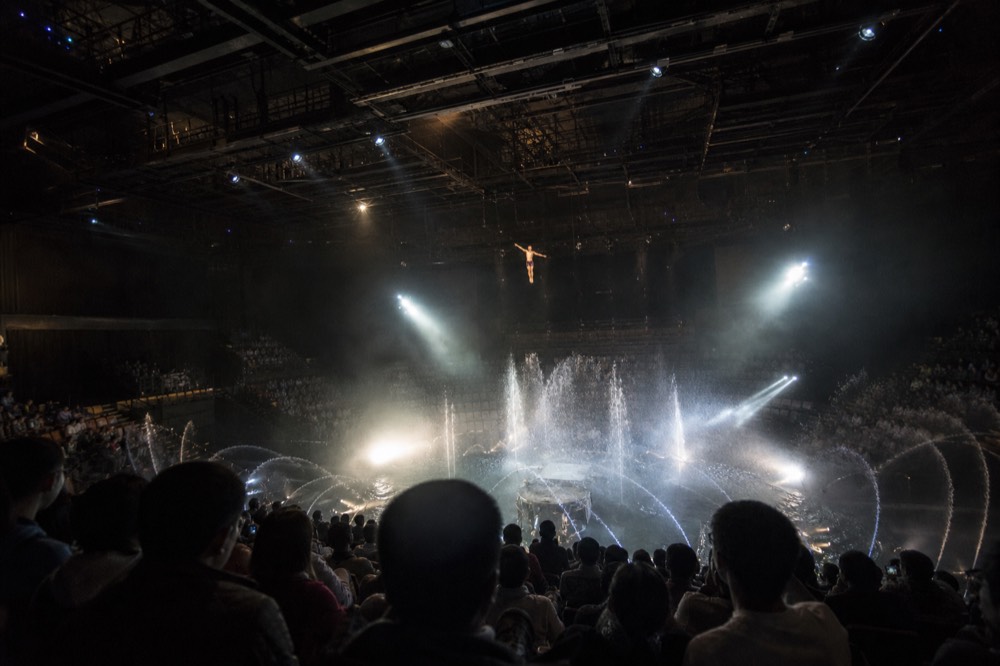
The diving is the sequence most trailers cut to, and it earns the cut. A 25-metre dive gives the diver roughly two and a half seconds of freefall, long enough that the audience registers the body position changing from upright to head-first before entry. The show's engineering supports it: the pool has to be deep enough and wide enough that a diver entering at terminal-adjacent speed has margin in every direction, which is why the centre area is a full 65 feet across rather than a lap pool with a platform. The official programme describes the production as involving Olympic athletes, aerialists, divers and engineers within its company.
The motorcycle sequence is the show's loudest contrast. Riders use ramps and the raised stage platforms to jump across the water surface while pyrotechnics and motorbike stunts are listed among the show's declared effects. The staging logic is deliberate: after several minutes of silent swimming and aerial work, the engine noise and detonations reset the audience's attention. The official effects warning also lists flashing lights, fog, liquid nitrogen and animation, so anyone with light or sound sensitivities should know what is coming, and the show is not recommended for children aged 6 or under in any seat.
The mix of disciplines is what separates this from a diving exhibition or a stunt show alone. Aerialists work on rigging above the pool, divers work below it, motorcyclists work across it, and clowns and character work fill the transitions while the elevators cycle underneath. The story and characters of the show give the sequences a frame, but the frame is light: you are watching a relay of physical specialities performed over a machine that keeps changing the floor.
What Does The Aerial Rigging Do Above The Water?
Aerial performers work on rigging suspended directly above the pool, combining bungee, silks and counterweight work with the water sequences below, so a single scene can move from underwater swimming to flight without a set change. The rigging is part of why the 270-degree house works: the action travels vertically as well as horizontally, and there is no front-of-stage blind spot for a raised act.
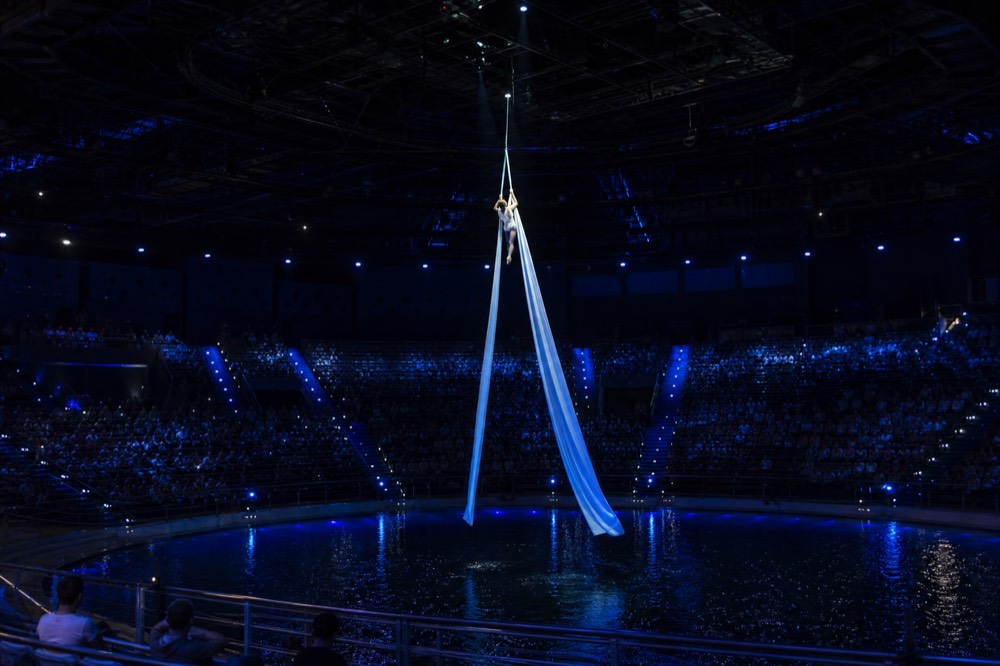
In a conventional theatre, aerial work is constrained by the proscenium: the audience sees a flat rectangle, and anything flown has to stay inside it. Here the rigging can rotate the action to face different sides of the house, and the show uses that. Scenes begin with a diver entering the water on one side of the circle and end with an aerialist landing on a platform on the opposite side, pulling the audience's heads around the room. The theatre's 16 underwater cameras and over 200 safety devices exist because performers transition between air and water in the same beat, which is the riskiest category of staging in the production.
The music supports the verticality. The current production retains original themes by Benoit Jutras, who scored the 2010 show, alongside new themes and new arrangements, so long-time Macau visitors will hear continuity rather than a full replacement score. Costumes designed by Valentina Davoli have to survive repeated soaking, which shapes their look: heavy fabrics and anything that traps water are out, and the visual language leans on form-fitting, quick-drying designs that read clearly from the back of a 2,000-seat house.
Where Should You Sit For A Water Stage, And What Does Each Zone Cost?
The theatre sells five standard zones, from Gallery at MOP 698 to Golden Circle at MOP 1,598, plus VVIP boxes at MOP 28,000 or 38,000, and the splash area is rows A and B of every section, not one designated block: waterproof gear is provided on those seats. Seats are assigned automatically in your chosen section at checkout, so the zone, not the exact row, is the decision you control.
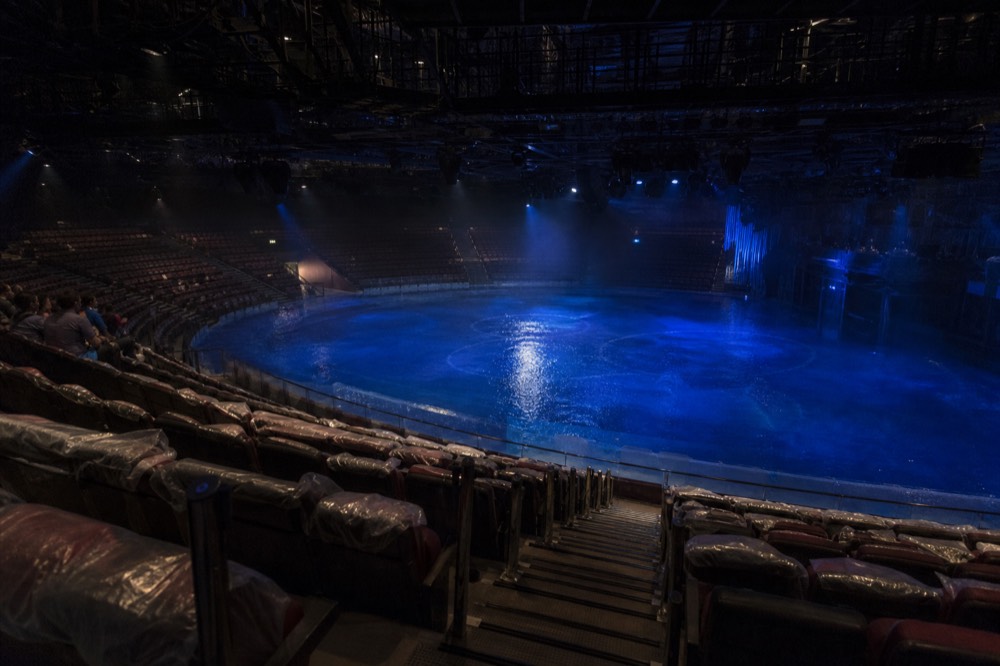
This is where a water stage genuinely changes the seating calculus, and it is the question the site gets most often. In a normal show, closer is simply better. Here, closer means wetter and lower: from row A you see the divers enter the water and feel the splash, but you look up at the aerial rigging and lose the geometry of the stage conversions. From the upper rows of any section you watch the floor appear and disappear, which is the show's most impressive single effect, and you see the fountain walls form before the people near the front even register the water moving. Higher zones buy proximity to the pool; upper rows buy the full picture of the stage transformations. Our full House of Dancing Water seating plan guide breaks the sections down seat by seat.
| Zone | Official price (MOP) | What the venue says | Splash exposure |
|---|---|---|---|
| Gallery | 698 | Entry tier | Rows A and B only |
| Signature | 898 | Second tier | Rows A and B only |
| Grand | 1,098 | Third tier | Rows A and B only |
| Premium | 1,298 | Centre of the theatre, exceptional views, double seats available | Rows A and B only |
| Golden Circle | 1,598 | One themed drink plus free flow of selected food and beverages | Rows A and B only |
| VVIP Box | 28,000 or 38,000 | Themed drinks, dining, meet and greet with performers | Private box, Level 2 |
The official FAQ confirms the splash policy in plain terms: waterproof gear is provided on the seats at the first two rows in all sections, and towels are additionally provided in the 300, 400 and 500 sections. So a family that wants to stay dry can book the same zone as a family that wants to get soaked, one row apart. Note the seat allocation rule when you book: the ticketing system automatically assigns the best available seats in your preferred section at the time of the transaction, so you cannot cherry-pick row C of Premium to guarantee dryness. If staying dry matters, choose a zone and accept the row, or check what the listing shows for your section before paying.
The ticket itself is the same product across all zones: the 90-minute show, the same entrance at the northeast corner of City of Dreams Level 1, opposite the Jin Ying restaurant, and the same arrival rule of at least 15 minutes before curtain. You can see current availability across the zones on the operator's live listing for the House of Dancing Water ticket, where the from-price and the zone options are shown together.
How Long Is The Show, And When Does It Run?
The show lasts about 90 minutes with no intermission, performs twice a day on operating days, and is normally dark on Mondays and Tuesdays, with closure days adjusted around public holidays. Showtimes are seasonal: 16:30 and 19:30 have applied for the June to October 2026 period, but times have varied across the year, so the operator's calendar is the only reliable source for a specific date.
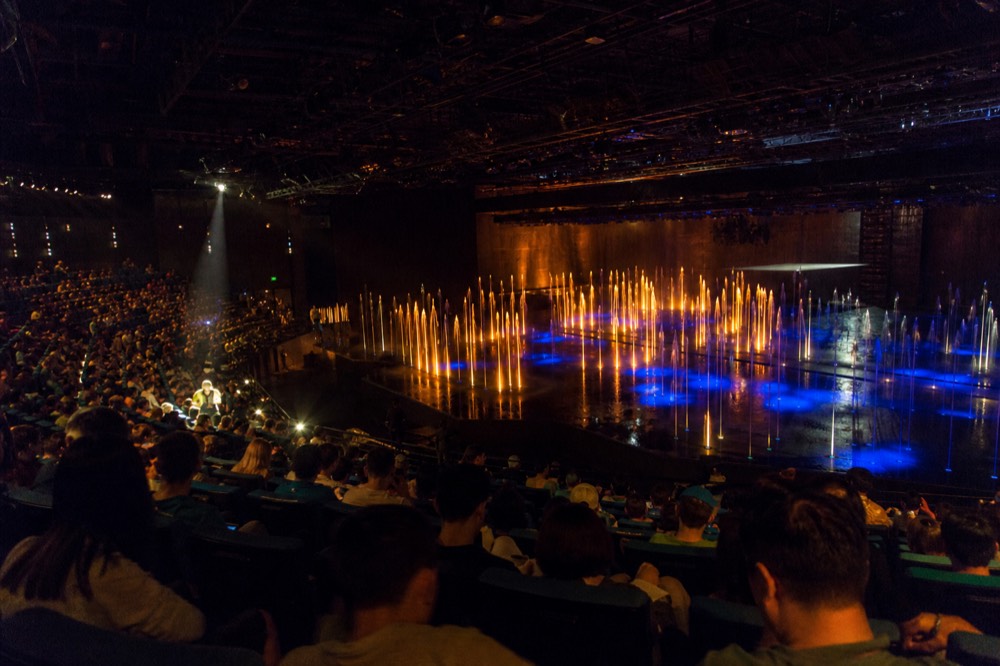
The no-intermission format matters for planning more than it looks. Ninety minutes straight means no bathroom break inside the show, and latecomers are only admitted at appropriate times as instructed by staff, not at will. The official terms say you should arrive at least 15 minutes before the start, and at least an hour before if you need to collect a physical ticket. Because the 19:30 performance ends around 21:00, dinner plans afterwards inside City of Dreams are comfortable, and the resort's restaurants, including the three-Michelin-starred Jade Dragon in the same complex, are the obvious extension of the evening. Our show times guide tracks the schedule detail.
| Schedule fact | Current state | Caveat |
|---|---|---|
| Duration | About 90 minutes, no intermission | Fixed by the production |
| Shows per operating day | Two | Fixed pattern |
| Dark days | Normally Monday and Tuesday | Adjusted around public holidays |
| Showtimes, June to October 2026 | 16:30 and 19:30 | Seasonal; has varied across the year |
| September 2026 | A dark period of 7 to 22 September is listed by ticket retailers, consistent with the official ticketing calendar showing performances resuming 23 September | Check your date before booking |
| Arrival | At least 15 minutes early; 1 hour to collect a physical ticket | Enforced at the door |
That September dark period deserves a plain warning. Retail listings and the pattern of on-sale dates on the official ticketing calendar both point to the theatre going dark in the middle of September 2026, which is consistent with an annual maintenance window, but the operator does not publish a fixed annual schedule. The practical rule: never assume a date is playing, always check the calendar for your specific evening, and be aware that typhoon season runs June to October, when a Signal 8 warning suspends transport across Macau and the show announces on its official site whether it proceeds.
What Are The Rules, Ages And Effects Warnings?
The show is not recommended for children aged 6 or under, children aged 12 or under must be accompanied by an adult, and every audience member regardless of age needs a valid ticket, though an adult may share a seat with a child aged 2 or under for free. The declared effects include flashing lights, loud audio, fog, pyrotechnics, liquid nitrogen, splashes to the front rows and motorbike stunts.
The age rules are the ones families ask about most, and the official FAQ is precise. A child aged 2 or under shares an adult's seat free, one child per adult, with the child's ID ready on request. Everyone else holds a ticket. The 6-and-under recommendation exists because of the effects: the show is loud, it is bright in sequences, and the motorbike stunts generate real engine noise at close range in the front rows. For visitors with light-sensitive children, the matinee at 16:30 is the same production, so the choice is purely logistical.
Photography is the rule people get wrong. Personal photography without flash is allowed, but video recording, flash and laser pointers are strictly prohibited, and the terms ban professional equipment including cameras with removable lenses, tablets and action cameras. The safe reading: a phone, held up briefly, no flash, no video. There is a cloakroom near the theatre foyer for strollers and luggage, 20 wheelchair seats in the last row with an accessible washroom in the foyer, and special seating requests go through the show enquiry line at +853 8868 6767. Parking is generous: three hours free for all visitors, plus another three with a same-day show ticket redeemed at the Dancing Water Boutique. Dress is simply appropriate clothing with shoes, and outside food and drink are forbidden.
| Rule | Official position |
|---|---|
| Minimum practical age | Not recommended for 6 and under; 12 and under must be accompanied by an adult |
| Infants | Child 2 or under shares a seat free, one per adult, ID on request |
| Tickets | Every audience member regardless of age must hold one |
| Photography | Personal photos allowed; flash, video and laser pointers prohibited; professional equipment banned |
| Effects warning | Flashing lights, loud audio, fog, pyrotechnics, liquid nitrogen, splashes to front rows, motorbike stunts |
| Food and drink | Outside food and beverage forbidden; concessions sell snacks and drinks |
| Strollers and luggage | Cloakroom storage near the theatre foyer |
| Dress | Appropriate clothing; shoes required |
How Do You Get Tickets, And What Do The Options Cost?
Tickets are sold in five seat zones from MOP 698 Gallery to MOP 1,598 Golden Circle, with VVIP boxes at MOP 28,000 or 38,000, and an early-bird price of MOP 558 applies to Gallery, Signature and Grand seats booked 14 days ahead. The venue also sells add-ons: a backstage tour from MOP 888, a Show and Dine package for MOP 100 more than a ticket, and a ferry-and-show package from MOP 798.
The official price ladder is transparent, which is unusual for a headline Macau attraction, and the zone names map exactly onto the physical tiers described above. The early-bird offer is the single biggest saving available: 20 percent off designated zones when you book two weeks out, which brings Gallery down from MOP 698 to MOP 558. The Open Date Ticket option gives 180 days of flexibility on when you attend, which suits visitors whose Macau day is not yet fixed. The Alain Ducasse at Morpheus package, from MOP 3,498 per person, pairs a tasting menu at the two-Michelin-star restaurant in the neighbouring Morpheus tower with a Golden Circle ticket. All prices are in MOP on the official channels.
| Offer | Price (MOP) | What it includes |
|---|---|---|
| Standard ticket, Gallery to Golden Circle | 698 to 1,598 | One seat in your chosen zone |
| Early Bird | From 558 | 20% off Gallery, Signature and Grand, booked 14 days ahead |
| Open Date Ticket | Varies by zone | 180 days of flexibility on the visit date |
| Backstage tour | From 888 | About 45 minutes after the evening show, minimum age 12 |
| Show and Dine | Ticket price plus 100 | A MOP 400 dining voucher or set |
| Show and Sail | From 798 | Round-trip Hong Kong to Macau ferry ticket plus one show ticket |
| VVIP Box | 28,000 or 38,000 | Private box, themed drinks, dining, meet and greet |
Booking through the operator's live listing is the route most visitors take, and it shows the same zones with live availability for your date. If your travel dates are loose, the Open Date Ticket is the product built for you; if they are fixed, the early-bird window rewards committing two weeks early. For the full cost breakdown including what a visit adds up to, see our piece on how much a ticket costs.
Getting to the theatre is covered in detail elsewhere on the site, but the short version for the show itself: City of Dreams sits in Cotai, the theatre entrance is on Level 1 at the northeast corner of the resort, and the resort runs free shuttle buses from the ferry terminals, the airport, the HZMB port and the border crossings, with the schedule published on the operator's getting here page. If you are planning the whole crossing from Hong Kong, start with our Hong Kong to Macau ferry guide.
The questions below cover the essentials in one place: what the show is, how the pool converts to a stage, whether you get wet, how high the dives are, the age rules and which seat zone suits you. Each answer is drawn from the official FAQ and venue terms, so you can confirm the details before you book.
Common Questions About The Macau Water Show
What Is The Macau Water Show?
The Macau water show is The House of Dancing Water, a resident aquatic production at the Dancing Water Theatre inside City of Dreams, Cotai. It stages acrobatics, high diving, aerial work and motorcycle stunts over a 17 million litre pool, runs about 90 minutes with no intermission, and is normally dark on Mondays and Tuesdays.
How Does The Stage Turn From Water Into A Floor?
Eight 10-ton hydraulic elevators, driven by 32 hydraulic cylinders, raise platform segments flush with the water surface to form a solid stage and sink them again to open the pool. The conversion takes about a minute and happens repeatedly during the show.
Do You Get Wet At The Macau Water Show?
Only in the first two rows of each section. Rows A and B of every zone are the splash area, and waterproof gear is provided on those seats, with towels additionally provided in the 300, 400 and 500 sections. From row C onward you stay dry.
How High Are The Dives In The Show?
Divers fall from heights of up to 25 metres, roughly eight storeys, into the centre pool. The pool's 65-foot centre area gives the margin that makes those entries safe.
Is The Show Suitable For Children?
The show is not recommended for children aged 6 or under, and children aged 12 or under must be accompanied by an adult. An adult may share a seat with a child aged 2 or under for free. The declared effects include flashing lights, loud audio and pyrotechnics.
Which Seat Zone Is Best At The Water Show?
Premium sits in the centre of the theatre with the strongest overall views, while Golden Circle adds a themed drink and free-flow food and beverages. Upper rows of any zone show the stage transformations best; rows A and B trade the full picture for proximity and splash.
The pool, the elevators and the 270-degree house are the show, and no trailer conveys the moment the floor appears out of the water in front of you. Pick the zone that matches whether you want to feel the splash or see the geometry, check the calendar for your date, and let House of Dancing Water Tickets handle the rest.